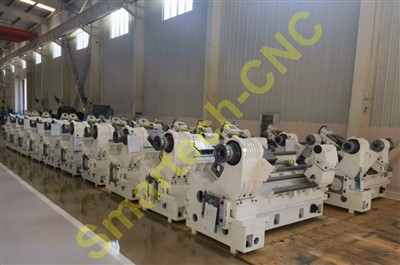
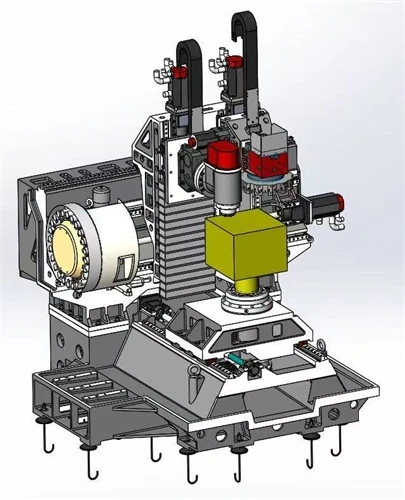
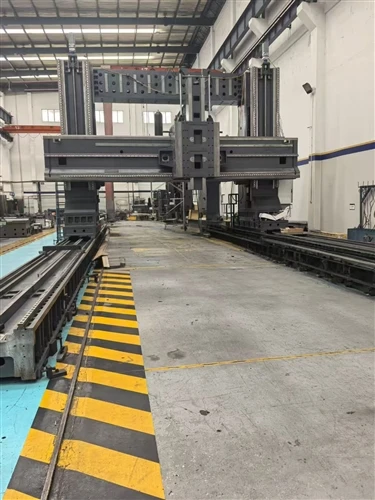
Horizontal machining centers are classified into fixed-column and moving-column types based on whether the column moves. Fixed-column types include table cross-motion, spindle box cross-motion, and spindle box side-mounted with column types. Moving-column types include planer table, column cross-motion, and spindle ram feed types.
The main body typically uses a high-quality cast iron bed and column, with the column employing an integral frame structure to ensure thermal symmetry and structural stability. Linear drive devices often use servo motors, linear rolling guide pairs, and precision ball screw pairs to achieve high-speed movement and accurate positioning. The spindle box and the front and rear supports of the spindle assembly often use imported multi-unit high-precision combined bearings, and external circulation forced cooling is used to reduce thermal drift. The end-gear indexing rotary table (B-axis) uses a high-precision end-gear to ensure positioning accuracy. The automatic tool changer (ATC) often uses a cam-type robotic arm with a single-arm, double-jaw exchange method.
Compact design is a growing trend; for example, the Mazak UN-600/30H significantly reduces machine width by offsetting the column (U-axis) with the X-axis of the worktable. Compact horizontal machining centers with even smaller footprints have also appeared on the market.