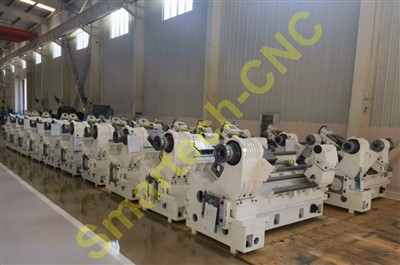
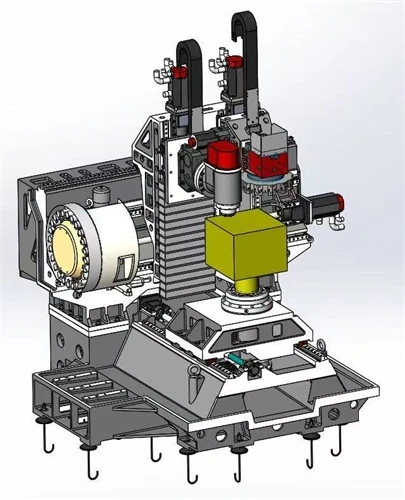
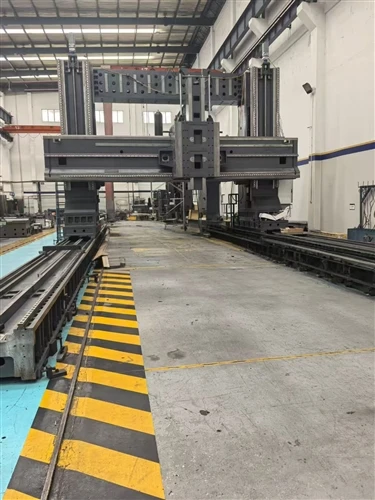
The development of heavy-duty machine tools will exhibit two major trends. On the one hand, technologically, the development direction is towards machining centers or large flexible machining units and large combined composite machining centers. Horizontal boring and milling machines will gradually be replaced by high-speed machining centers and flexible machining units. Floor-type milling and boring machines will primarily develop into large combined composite machining centers, that is, composite machining centers composed of two or more main machines. This is to adapt to the characteristics of single-piece, small-batch production of large machined parts, which involves complex processes, long auxiliary time, and long processing cycles. Often, it is difficult for a single machine tool to complete all machining operations, but two combined machining centers can fully achieve this. For example, two CNC gantry boring and milling machines can form a composite machining center, sharing the bed and guideways, each equipped with a rectangular worktable and a rotary worktable (indexing), capable of boring and milling operations. A floor-type milling and boring machine and a CNC single-column vertical lathe can form a large composite machining center, sharing the bed and guideways, equipped with a floor platform and a rotary table, capable of turning, boring, milling, drilling, and other machining operations; the rotary table can be indexed. There are also various combination forms, such as two large floor-type milling and boring machines sharing a bed guideway. This saves floor space, reduces costs, and improves processing efficiency. Another development trend is the pursuit of precision manufacturing, increasing the technological content of equipment manufacturing, and reflecting the safety, environmental protection, and human-centered design characteristics of machine tools.
In summary, the technology of contemporary horizontal milling and boring machines and floor-type milling and boring machines is developing very rapidly. This is mainly reflected in the updating of design concepts and significant improvements in machine tool operating speed and manufacturing process levels. On the other hand, there are also significant changes in machine tool structure and the continuous emergence of new technologies. The structure of horizontal milling and boring machines is developing towards high-speed electric spindles, while floor-type milling and boring machines are developing towards ram-type (boring spindle-less) structures. Functional accessories are showing a trend towards high speed, multi-axis linkage, and diversified structural forms. This will be the new trend of technological development in the future.